Justice or Injustice? Sri Lanka's 200-Year Sentence and Saudi Arabia's Death Penalty for a Deleted Post Draw Global Scrutiny
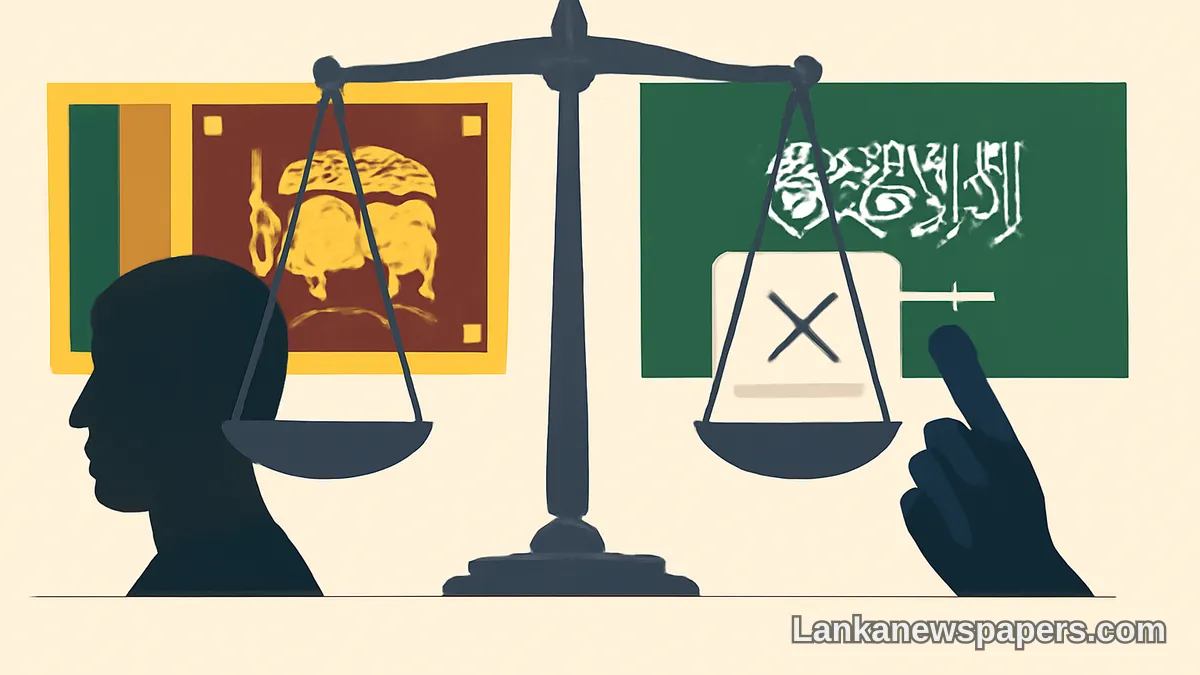
Two landmark legal cases from opposite ends of the world have ignited an urgent conversation about the nature of justice, proportionality, and human rights — and the contrast between them could not be more stark.
Sri Lanka: 200 Years for the Loss of 278 Lives
In Sri Lanka, a court handed down a staggering 200-year prison sentence in connection with a case involving the deaths of 278 people. The sentence, while numerically dramatic, has prompted serious reflection among legal observers and civil society groups about what true accountability looks like when hundreds of lives are lost.
Critics have questioned whether such a sentence — one that far exceeds any human lifespan — represents genuine justice for the victims and their families, or whether it serves more as a symbolic gesture that papers over deeper systemic failures. For the grieving families of those 278 individuals, the weight of the verdict carries both a measure of closure and lingering uncertainty about whether the full truth has been told.
The case has renewed public debate within Sri Lanka about the effectiveness of its judicial system in delivering meaningful accountability, particularly in large-scale tragedies where institutional negligence or criminal misconduct may have played a role.
Saudi Arabia: A Death Sentence for a Deleted Social Media Post
On the other side of the globe, a case emerging from Saudi Arabia has sent shockwaves through the international human rights community. An individual is facing the death penalty — not for violence, not for physical harm to another person — but for a social media post that was subsequently deleted.
Human rights organisations have condemned the sentence in the strongest possible terms, describing it as a chilling example of how digital expression is being weaponised by authoritarian governments to silence dissent. The case underscores a growing global trend in which online speech — even speech that the author themselves has retracted — is treated as a capital offence in certain jurisdictions.
The Saudi case has drawn condemnation from international bodies and press freedom advocates, who warn that such rulings have a devastating chilling effect on free expression not only within Saudi Arabia but across the broader region.
A Troubling Contrast That Demands Reflection
Placed side by side, the two cases present a deeply uncomfortable question: what does the world's legal landscape truly value?
- In one country, the loss of nearly 300 human lives results in a centuries-long prison term that carries uncertain symbolic weight.
- In another, the act of posting — and then deleting — words on a screen is deemed worthy of execution.
Legal analysts and human rights advocates argue that both cases, in very different ways, reveal the fragile and often politically shaped nature of justice systems around the world.
When a deleted post carries a heavier penalty than the deaths of hundreds, the global community must ask itself what values its institutions are truly upholding.
For Sri Lankan readers, the contrast is not merely an abstract global conversation. Sri Lanka itself has grappled with questions of accountability, reconciliation, and justice for decades — from the aftermath of the civil war to more recent tragedies. Understanding how justice is administered, and distorted, elsewhere offers a mirror for examining the country's own ongoing legal and moral reckoning.
The Broader Human Rights Dimension
International human rights groups have called on governments worldwide to ensure that sentencing remains proportionate, transparent, and grounded in universally recognised legal principles. They warn that when justice systems become tools of political messaging — whether through impossibly long prison terms or executions for speech — public trust in the rule of law erodes for everyone.
As both cases continue to draw international attention, they serve as a sobering reminder that the pursuit of genuine justice remains an unfinished and deeply contested project across the globe.

💬 Join the Discussion 3
See what readers are saying — and add your view.
saudi situation is scary but lets fix our own justice system first no?
200 years means nothing if he walks free in 10. we know how it goes here.
exactly, goverment will find some way to quietly release.