Politics
Govt. to introduce major higher education reforms aligned with school education changes - PM
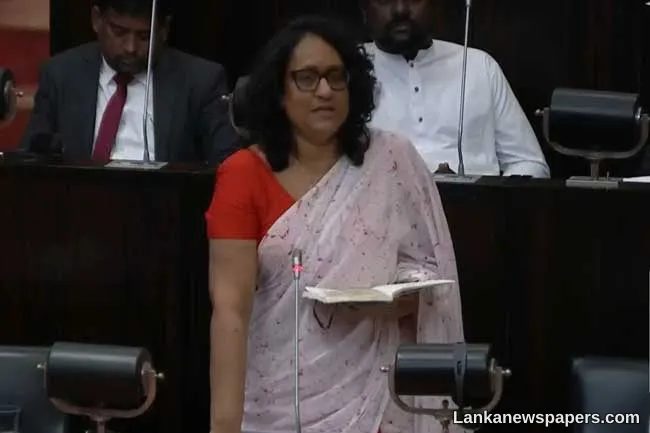
Prime Minister Dr. Harini Amarasuriya announced that the Government of Sri Lanka plans to make significant changes in higher education to match the new reforms for primary and secondary education. She shared this information in parliament while answering questions from MP Manjula Sugath Rathnayaka, as reported by the Prime Minister’s Media Division. The Prime Minister explained that a special expert committee has been working for six months to identify problems in the higher education sector. They will suggest necessary reforms based on their findings. For the 2025 G.C.E. Advanced Level Examination, 281,810 students participated, with 176,538 qualifying for university entry. The breakdown of students who qualified by subject is as follows: 32,935 in Biological Sciences, 23,012 in Physical Sciences, 39,608 in Commerce, 58,269 in Arts, 4,199 in the General Stream, 12,472 in Engineering Technology, and 6,043 in Bio-Systems Technology. A total of 42,937 students are expected to be admitted to universities. The Government aims to improve education quality while also enhancing university facilities for students. They have decided to keep the first-degree admission numbers the same as in previous years. Additionally, a new Geographic Information Systems course will start at the University of Ruhuna, and an Electronic and Intelligent Systems Engineering course will be offered at the University of Peradeniya beginning in the academic year 2025/2026. Each program will enroll fifty students. The cut-off marks have already been released, and registration lists will be sent to the respective universities. In response to MP K. Kader Mastan's question about preschool education, the Prime Minister mentioned that most preschools are privately run, meaning the Ministry cannot offer permanent jobs or salaries for their staff. However, they are taking steps to give allowances to volunteer teachers in selected preschools under Provincial Councils. By 2027, a major reform for the preschool education system is planned, involving collaboration between the Ministry of Education and the Ministry of Women and Child Affairs. Furthermore, a national policy to regulate preschool education, based on National Education Commission recommendations, is set to be created in 2026. This policy will include teacher guidelines and activity manuals, along with plans for teacher training programs at the provincial level.

💬 Join the Discussion 0
Be the first to share your view on this story.