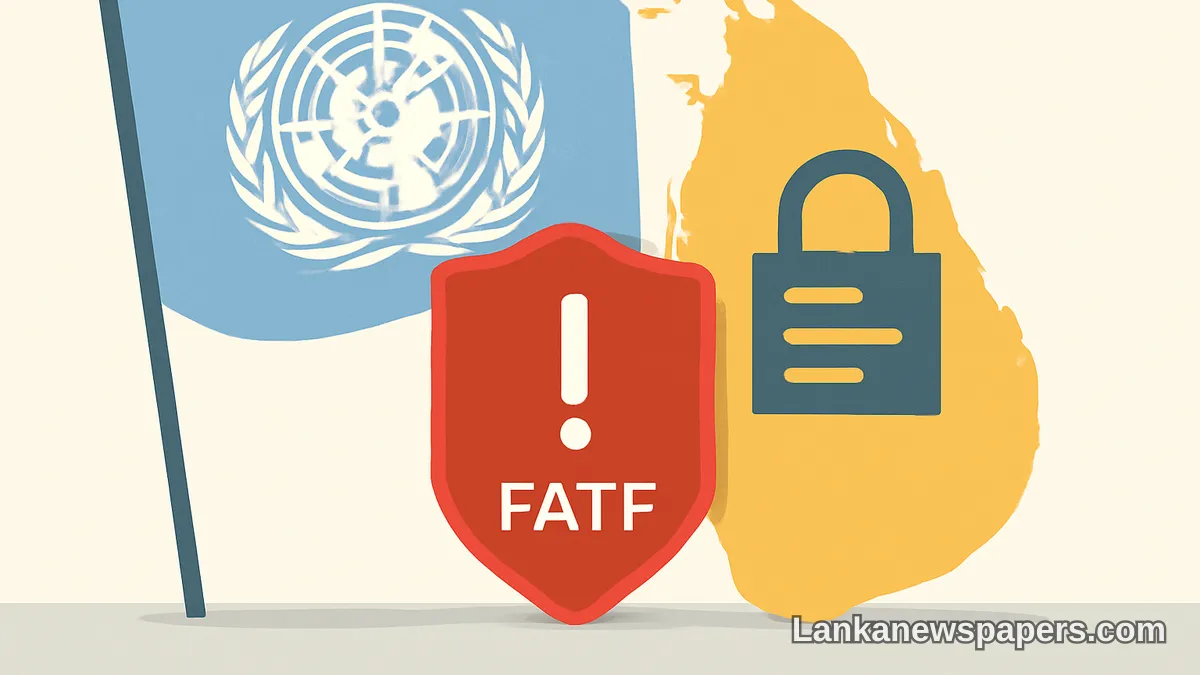
The United Nations has issued a stark warning to Sri Lanka, cautioning that the island nation could jeopardise its standing with the Financial Action Task Force (FATF) if it continues to impose blanket restrictions that run counter to internationally accepted anti-money laundering and counter-terrorism financing standards.
FATF Compliance Under Scrutiny
Sri Lanka is currently working to exit the FATF grey list, a designation that has cast a shadow over the country's financial reputation and complicated its engagement with international markets and lending institutions. However, the UN has flagged that certain broad-brush regulatory measures being applied domestically could undermine rather than strengthen the country's case before the global financial watchdog.
According to the warning, blanket curbs — measures applied uniformly across sectors or entities without adequate risk-based assessment — are inconsistent with the FATF's recommended approach, which emphasises targeted, proportionate action based on identified risks.
What the UN Is Saying
Rather than applying sweeping restrictions, countries are expected to demonstrate a nuanced, risk-sensitive framework that targets illicit financial activity without unnecessarily disrupting legitimate economic activity.
The UN's position aligns with long-standing FATF guidance that member and monitored states should adopt a risk-based methodology when designing and implementing financial controls. Indiscriminate restrictions, the body argues, can harm civil society organisations, non-governmental groups, and the broader business community while failing to effectively address actual threats.
Implications for Sri Lanka's Economic Recovery
For Sri Lanka, which is still navigating a fragile economic recovery following the 2022 financial crisis, remaining on the FATF grey list carries significant consequences. These include heightened scrutiny of financial transactions, increased compliance costs for banks and businesses, and reduced investor confidence at a time when the country urgently needs foreign capital inflows.
Exiting the grey list is therefore considered a priority for the current administration, making the UN's warning particularly timely. Policymakers will need to carefully reassess whether existing regulatory measures meet the proportionality and risk-based standards that FATF evaluators will examine during the country's next assessment.
A Delicate Balancing Act
Sri Lanka now faces the challenge of tightening its financial oversight mechanisms in a manner that satisfies FATF's technical requirements without resorting to broad restrictions that could draw further criticism from international bodies. Legal experts and financial sector stakeholders have previously called on the government to refine its legislative and regulatory framework to ensure it is both effective and compliant with global norms.
The UN's intervention adds a new layer of urgency to those calls, signalling that the path to grey list removal demands precision and international cooperation rather than sweeping measures that may do more harm than good.


💬 Join the Discussion 4
See what readers are saying — and add your view.
FATF blacklist means no foreign transactions, ppl dont realise how serious this is
what exactly are these "blanket restrictions" they talking about?
goverment doesnt listen to anyone, now UN also saying same thing
they will listen when we get blacklisted, not before