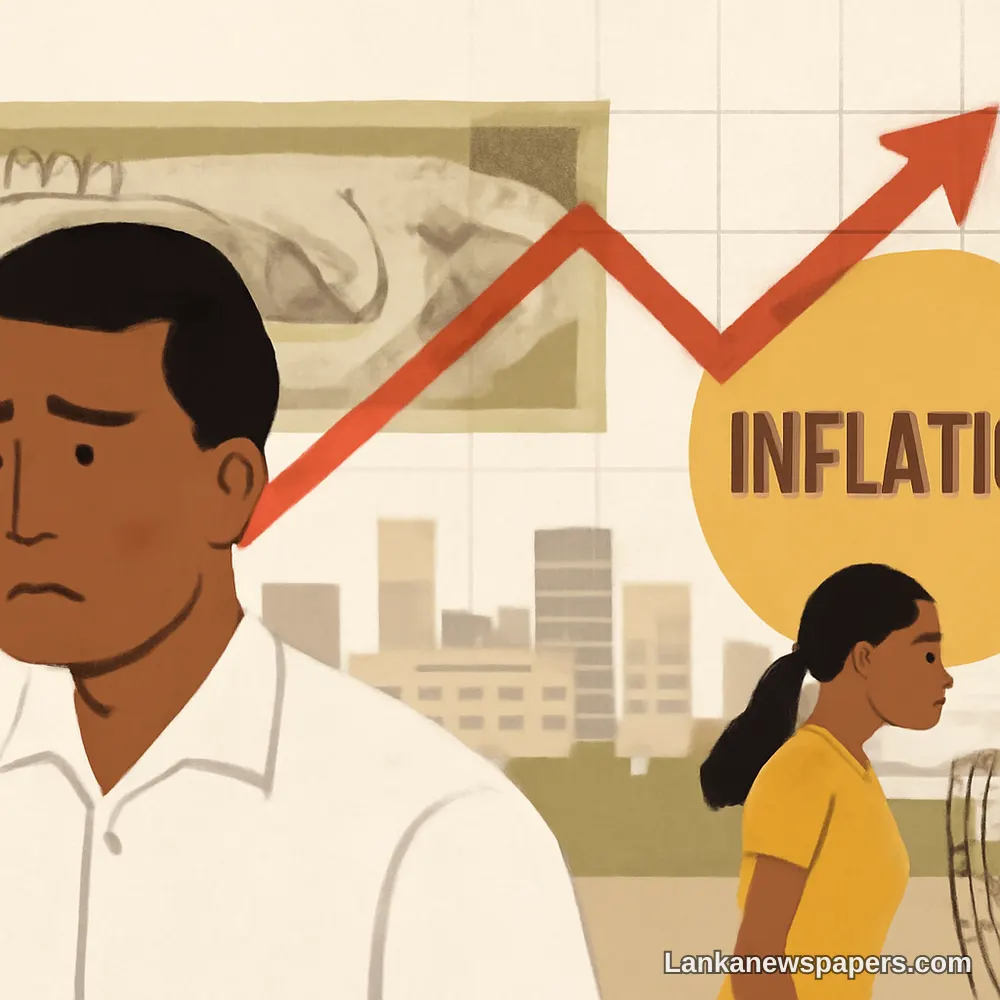
A Burden Few Recognise But Everyone Feels
When Sri Lankans think of taxation, they typically picture income tax deductions, VAT on goods, or levies at the customs gate. But there exists another form of taxation — one that carries no official name on a government form, draws no public debate in Parliament, and yet quietly erodes the purchasing power of every citizen in the country. That burden is inflation.
What Makes Inflation a "Hidden Tax"
Unlike conventional taxes, inflation is not collected by a government officer or itemised on a receipt. It operates silently, reducing the real value of the money people hold in their wallets and bank accounts. When the price of rice, fuel, or medicine rises faster than wages, households effectively lose a portion of their income without a single rupee being formally deducted. Economists have long described this phenomenon as a hidden tax precisely because it redistributes wealth away from ordinary people — particularly those on fixed incomes — toward those who hold assets that appreciate in value.
In Sri Lanka's recent experience, this reality has been painfully tangible. Following the unprecedented economic crisis of 2022, the country witnessed inflation spike to record levels, devastating household budgets across all income groups. Though inflation has since moderated, the cumulative damage to living standards has not been erased.
Who Bears the Greatest Burden
The hidden tax of inflation does not fall equally on all citizens. Its weight is most crushing on:
- Low and middle-income families who spend the majority of their earnings on essential goods such as food, transport, and healthcare
- Senior citizens and pensioners relying on fixed monthly payments that do not adjust with rising prices
- Informal sector workers whose wages lag significantly behind price increases
- Small business owners facing higher input costs they cannot always pass on to consumers
Wealthier individuals and institutions, by contrast, often possess assets such as property, equities, or foreign currency holdings that serve as natural hedges against inflation — further widening the gap between Sri Lanka's economic classes.
The Role of Monetary and Fiscal Policy
Inflation does not emerge from a vacuum. It is frequently the consequence of policy decisions — or the failure to make them in time. Excessive money printing to finance government deficits, unsustainable subsidies funded through borrowing, and delays in structural fiscal reform all contribute to inflationary pressure. In Sri Lanka's case, years of fiscal mismanagement culminating in the 2022 sovereign default provided a stark illustration of how policy failures translate directly into a cost-of-living catastrophe for ordinary people.
When a government cannot raise sufficient revenue through transparent taxation, it may resort to monetising its debt — effectively creating new money — which dilutes the value of every rupee already in circulation. The public pays the price, not through a declared tax, but through the grocery bill.
The Path Toward Monetary Stability
Combating the hidden tax of inflation requires sustained commitment on multiple fronts. The Central Bank of Sri Lanka has moved to strengthen its inflation-targeting framework, prioritising price stability as a core mandate. Maintaining central bank independence, avoiding the monetisation of government debt, and adhering to credible fiscal consolidation are widely regarded as essential steps in keeping inflation under control.
Structural reforms that improve productivity, reduce import dependency for essential goods, and broaden the formal tax base can also help address the root conditions that make economies vulnerable to inflationary spirals in the first place.
A Call for Greater Awareness
Perhaps the most important step is public awareness. Citizens who understand how inflation functions as a redistributive mechanism are better positioned to hold their leaders accountable for the monetary and fiscal choices that determine price stability. In a country still navigating the aftermath of its worst economic crisis in living memory, recognising inflation for what it is — a very real, if invisible, tax on national wealth — is not merely an academic exercise. It is a matter of economic survival for millions of Sri Lankan families.


💬 Join the Discussion 1
See what readers are saying — and add your view.
nothing hidden about it, we all feel it every single time we go to the pola