Sri Lanka Should Embrace Multi-Alignment Foreign Policy to Navigate Global Uncertainty, Says Former President
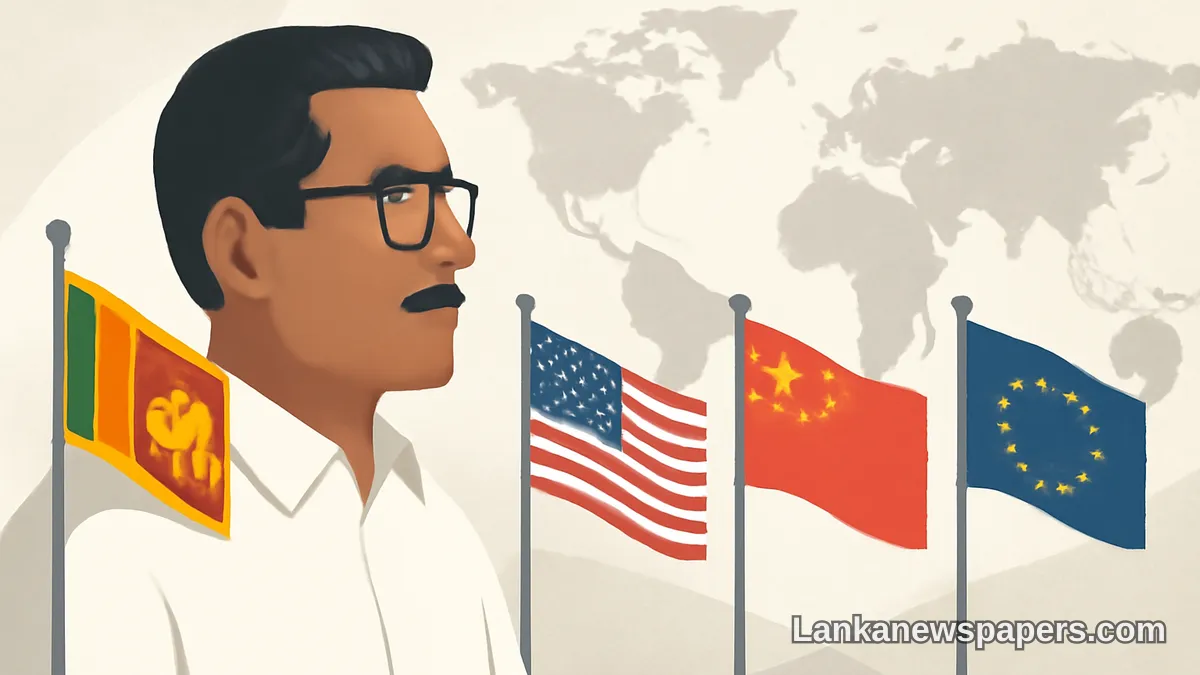
A former Sri Lankan president has called on the island nation to abandon its traditional foreign policy posture and adopt a multi-alignment strategy, arguing that the rapidly shifting dynamics of global geopolitics demand a more flexible and pragmatic diplomatic approach.
A Call for Diplomatic Flexibility
The former leader made the remarks amid growing international uncertainty, driven by intensifying rivalries between major world powers, shifting trade alliances, and economic turbulence that has left many smaller nations caught in the crossfire. According to the former president, Sri Lanka can no longer afford to lean exclusively toward any single bloc or superpower if it hopes to protect its national interests.
Multi-alignment, as a foreign policy concept, involves cultivating balanced and productive relationships with multiple major powers simultaneously — rather than anchoring a country's diplomacy to one dominant partner or alliance. Nations such as India, Indonesia, and the United Arab Emirates have in recent years successfully employed variations of this approach.
Why It Matters for Sri Lanka
For Sri Lanka, which is still recovering from a devastating economic crisis that brought the country to its knees in 2022, the stakes of foreign policy choices are particularly high. The country has relied heavily on financial assistance and investment from a range of partners including China, India, the International Monetary Fund, and Western nations.
Critics of Sri Lanka's past foreign policy have long argued that the country has at times tilted too far in one direction — most notably toward China during the Rajapaksa era — creating diplomatic friction with neighbouring India and Western partners. A multi-alignment framework, proponents argue, would allow Colombo to draw on a broader range of economic partnerships without triggering geopolitical tensions.
Sri Lanka must position itself strategically so that it can benefit from all sides of the global equation, rather than being pressured into choosing one camp over another.
Geopolitical Context
The former president's comments come at a time when the broader Indo-Pacific region is witnessing heightened competition between the United States and China. Sri Lanka, given its location along critical Indian Ocean shipping lanes, occupies a strategically significant position that makes it a point of interest for multiple global powers.
The country's deep-water ports, particularly Hambantota and Colombo, have already drawn considerable international attention, with competing powers viewing infrastructure investment in the island as part of a larger regional chess game.
Domestic Reception
The proposal is likely to resonate with segments of the Sri Lankan public and political establishment that have grown wary of the country becoming overly dependent on any single foreign patron. However, implementing a coherent multi-alignment policy requires considerable diplomatic capacity, institutional strength, and consistency — areas where Sri Lanka has historically faced challenges.
Policy analysts note that for multi-alignment to be effective, it must be accompanied by strong domestic governance, transparent deal-making with foreign partners, and a clearly articulated national interest framework that guides decision-making across successive governments.
As Sri Lanka continues its economic recovery and seeks to reestablish its standing on the world stage, the debate over the country's foreign policy direction is expected to intensify in the months ahead.


💬 Join the Discussion 4
See what readers are saying — and add your view.
goverment should focus on economy first, foreign policy can wait
multi-alignment just means taking money from everyone and pleasing nobody lah
finally someone talking sense, cant keep begging from one side only
but which former president? they all say smart things after leaving office