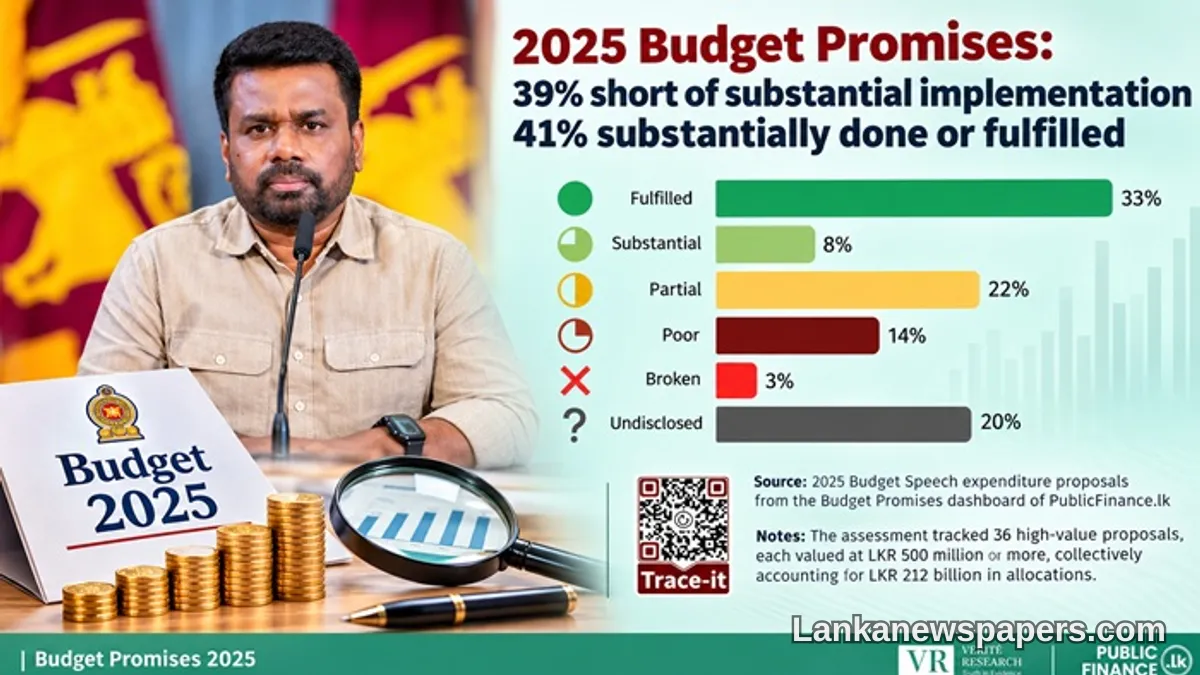
A significant portion of the Sri Lankan government's 2025 Budget proposals have failed to reach meaningful implementation, according to findings released by independent research organisation Verité Research.
The watchdog's assessment reveals that close to 40% of the budget commitments made for 2025 have not been substantially carried out, raising fresh concerns about the government's ability to translate fiscal pledges into concrete action on the ground.
Implementation Gap Remains a Persistent Challenge
Verité Research, which regularly monitors the execution of Sri Lanka's annual budget proposals, found that while some progress has been recorded across various sectors, a considerable share of commitments continues to lag behind expectations. The findings point to a recurring trend in which budgetary promises are announced with fanfare but face significant obstacles when it comes to actual delivery.
The report highlights that the gap between policy announcement and real-world implementation remains one of the most pressing governance challenges facing Sri Lanka, particularly at a time when the country is working to restore economic stability and rebuild public trust following a severe financial crisis.
Significance for Sri Lankan Citizens
For ordinary Sri Lankans, budget proposals often represent direct commitments on issues such as social welfare, infrastructure development, healthcare, and economic relief. When such pledges fall short of implementation, the impact is felt most acutely by those who depend on state programmes for their livelihoods and wellbeing.
Analysts have long argued that Sri Lanka must strengthen its institutional mechanisms for tracking and enforcing budget execution if the government is to demonstrate fiscal credibility, both to its citizens and to international stakeholders including the International Monetary Fund, with which the country is engaged in an ongoing bailout programme.
Calls for Greater Accountability
The Verité Research findings are expected to renew calls from civil society and opposition parties for greater transparency in how budget allocations are managed and monitored throughout the financial year. Critics argue that without robust accountability frameworks, the annual budget risks becoming little more than a list of aspirations rather than a binding roadmap for governance.
As Sri Lanka continues its journey toward economic recovery, observers say the government must treat budget implementation as a matter of national priority, ensuring that the commitments made to the public are met with the same urgency and discipline applied to meeting external debt obligations.

💬 Join the Discussion 3
See what readers are saying — and add your view.
which 60% they "fulfilled" though, want to see that list
40%? feels like every year same story, nothing changes
at least they admitting it this time no? usually just silence