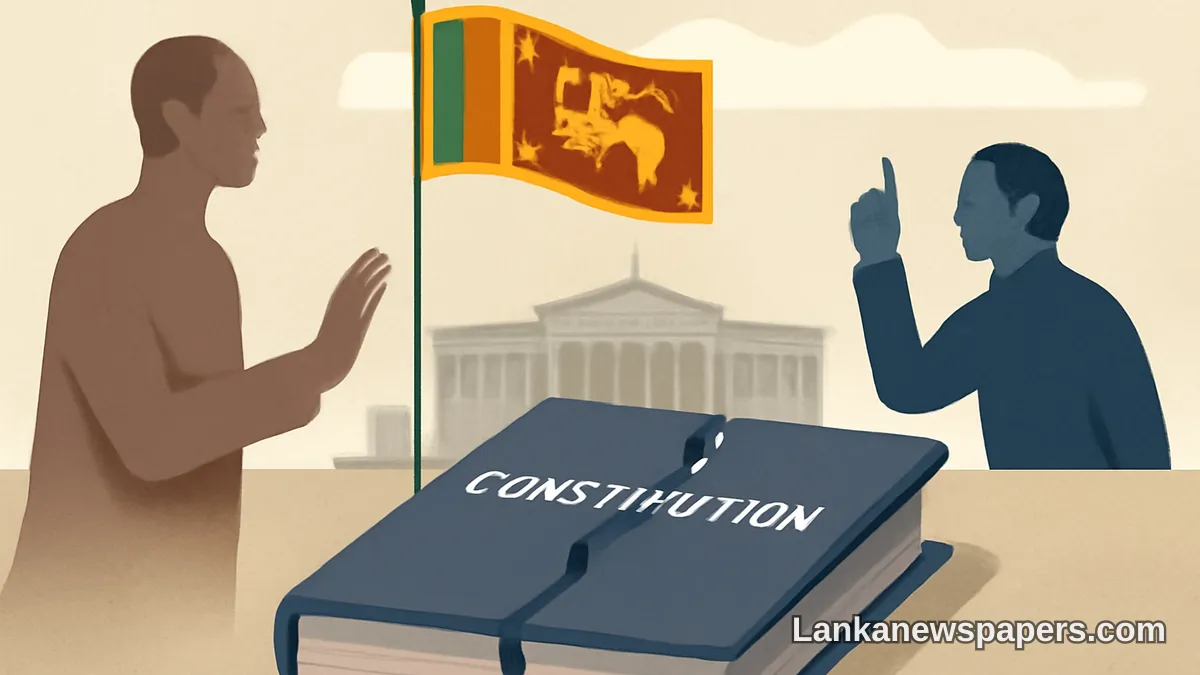
Old Fractures, New Pressures
Sri Lanka is once again facing deep-seated constitutional questions that have long complicated the island nation's political landscape, with longstanding fault lines resurfacing amid renewed debate over the structure and balance of power within the country's governing framework.
These tensions, which have periodically destabilised Sri Lankan politics over the decades, centre on fundamental disagreements about executive authority, legislative independence, and the distribution of power between the centre and the periphery — issues that have never been fully resolved since the country adopted its current constitutional framework.
A Constitution Under Scrutiny
Sri Lanka's 1978 constitution, which introduced the powerful executive presidency, has been a subject of controversy almost from its inception. Critics have long argued that the concentration of authority in the hands of a single elected executive has undermined democratic checks and balances, leaving parliament and the judiciary in a weakened position relative to the presidency.
While various administrations have promised constitutional reform over the years, meaningful and lasting change has repeatedly proven elusive. Proposals have stalled in parliament, fallen victim to political manoeuvring, or been abandoned altogether as successive governments found the existing framework advantageous to their own hold on power.
Ethnic and Regional Dimensions
The constitutional debate in Sri Lanka cannot be separated from its ethnic dimension. The question of devolution — specifically, how much autonomy should be granted to Tamil-majority regions in the north and east — remains one of the most sensitive and unresolved issues in the country's political life.
Successive governments have struggled to find a formula that satisfies Tamil political aspirations for meaningful self-governance while also addressing concerns among Sinhalese nationalist constituencies who view extensive devolution with suspicion. This tension has made genuine constitutional reform extraordinarily difficult to achieve.
The unresolved nature of Sri Lanka's constitutional framework continues to cast a long shadow over its democratic institutions and its prospects for lasting ethnic reconciliation.
Recent Political Context
The renewed focus on constitutional matters comes against the backdrop of significant political change in Sri Lanka. The country has in recent times undergone considerable shifts in its political leadership, with new administrations inheriting not only an acute economic crisis but also the unfinished business of governance reform that their predecessors left behind.
Civil society groups, legal experts, and opposition politicians have increasingly called for a new constitutional settlement that would reduce the dominance of the executive presidency, strengthen parliamentary oversight, and provide a credible framework for addressing minority rights and regional governance.
The Road Ahead
Analysts warn that failing to address these constitutional fault lines risks perpetuating a cycle of political instability that has repeatedly set back Sri Lanka's development. The economic crisis of recent years demonstrated starkly how weak institutional checks and poor governance can have devastating consequences for ordinary Sri Lankans.
- Reform of the executive presidency remains a central demand among constitutional reformers.
- The 13th Amendment, which provides for provincial councils, continues to be contested and inconsistently implemented.
- Calls for a new or substantially revised constitution have grown louder among civil society and minority political parties.
- International partners have expressed interest in seeing Sri Lanka pursue credible governance reforms alongside its economic recovery.
For Sri Lanka to build the stable, inclusive democracy its citizens deserve, observers argue, the country's leaders will eventually need to confront these constitutional questions with the seriousness and political courage that has so far been lacking. Whether the current political moment provides an opportunity for that reckoning remains to be seen.


💬 Join the Discussion 1
See what readers are saying — and add your view.
same old same old, every few years this constitution drama comes back