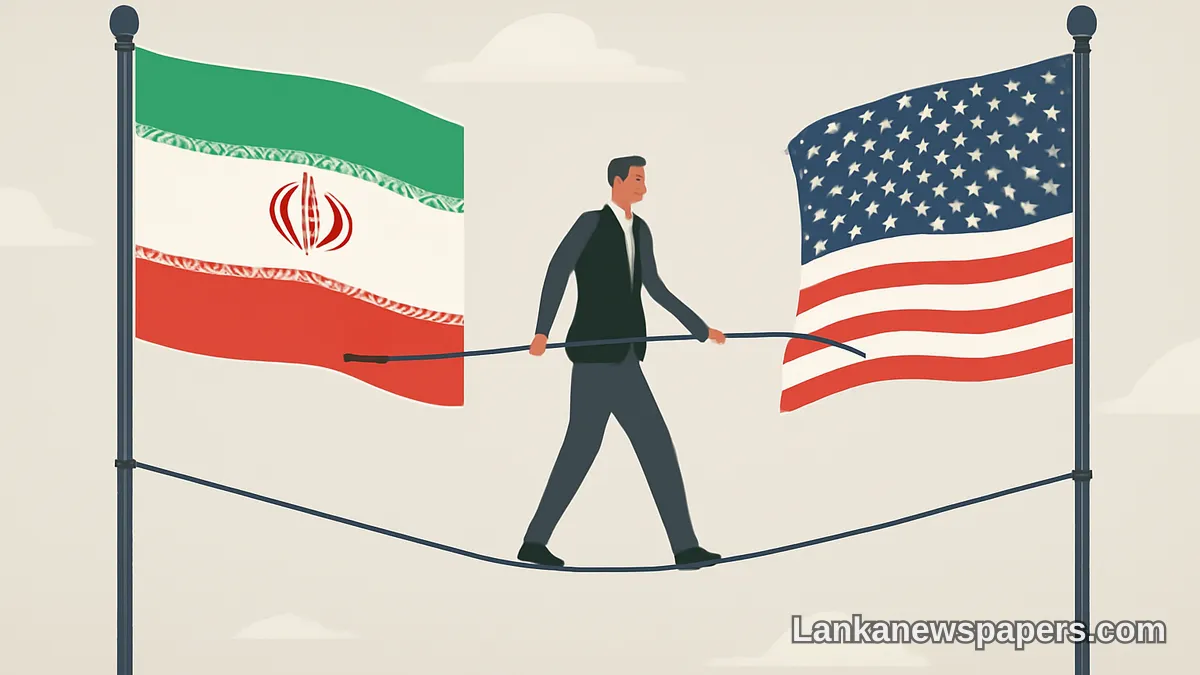
Non-Alignment Under Pressure
The escalating conflict between Iran and the United States has placed Sri Lanka's long-standing policy of non-alignment under significant strain, raising difficult questions about how Colombo can maintain balanced relationships with both nations amid one of the most volatile geopolitical standoffs in recent memory.
A Delicate Balancing Act
Sri Lanka has historically prided itself on a foreign policy rooted in non-alignment, a principle that guided the island nation through decades of Cold War rivalries and regional tensions. However, as Washington and Tehran move deeper into confrontation, Colombo finds itself caught between two powerful forces with which it maintains important diplomatic and economic ties.
The United States remains one of Sri Lanka's most significant trade partners and a key source of foreign direct investment, while Iran has historically been a vital supplier of crude oil and holds influence across parts of the Middle East that matter to Sri Lanka's diaspora and labour migration interests.
Economic Stakes Are High
Beyond the diplomatic dimensions, the conflict carries real economic consequences for Sri Lanka. Disruptions to Middle Eastern oil supply chains could deliver another blow to a country still recovering from its worst economic crisis in decades. Rising global oil prices, a direct risk of prolonged Iran-US hostilities, would place fresh pressure on Sri Lanka's import bill and foreign exchange reserves.
- Sri Lanka relies heavily on oil imports to meet its energy needs
- A spike in global crude prices could undermine the country's fragile economic recovery
- Sri Lankan workers employed in Gulf nations could face uncertainty if regional instability spreads
Diplomatic Credibility on the Line
Foreign policy analysts warn that how Sri Lanka navigates this crisis will define its diplomatic credibility for years to come. Taking sides — or even appearing to lean toward one power over the other — risks damaging relationships that Sri Lanka can ill afford to lose at a time when it is actively seeking international financial support and investment.
Sri Lanka's non-aligned stance is not merely a historical posture — it is a practical necessity given the country's economic vulnerabilities and its dependence on goodwill from multiple global partners.
Colombo's Path Forward
Government officials in Colombo have so far exercised caution, refraining from making strong public statements that could be interpreted as favouring either Washington or Tehran. This measured silence, while deliberate, will become increasingly difficult to maintain as the international community looks to smaller nations to take clearer positions on global security matters.
For Sri Lanka, the Iran-US conflict is not a distant geopolitical drama — it is a direct test of whether the country's foreign policy framework, built on dialogue and neutrality, can withstand the pressures of an increasingly polarised world order.


💬 Join the Discussion 1
See what readers are saying — and add your view.
small country like ours, best to stay neutral and focus on economy