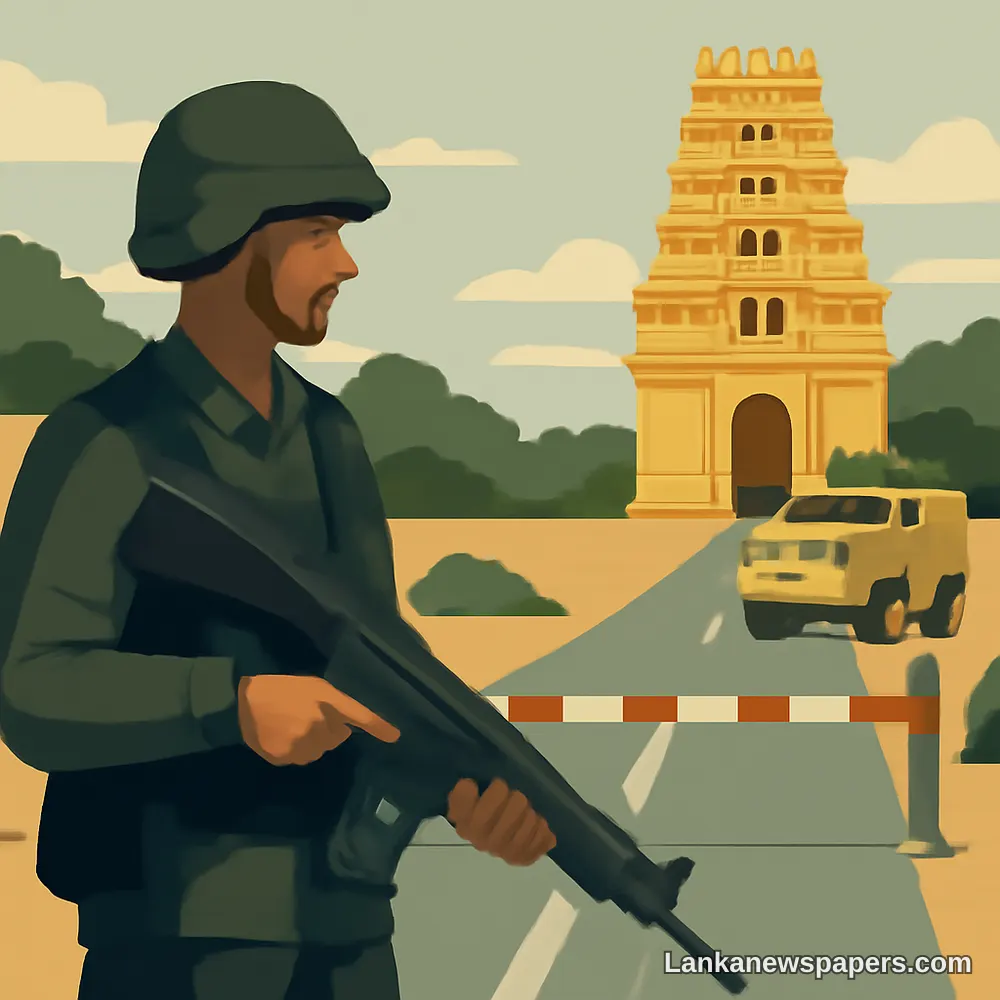
In a significant development for communities in the Northern Province, the Sri Lankan military has agreed to reopen a road leading to a temple in the Palaly area after more than three decades of restricted access, bringing relief and hope to Tamil devotees who have long sought the right to worship freely at the site.
Decades of Restricted Access
The road in question has remained closed for approximately 35 years, a period that encompasses the height of the civil war and its prolonged aftermath. The closure effectively denied civilians, particularly Tamil residents and Hindu devotees, the ability to reach the temple through a direct and traditional route, forcing many to either take lengthy alternative paths or abandon visits altogether.
For the affected communities, the temple holds deep religious and cultural significance. The prolonged inability to access it freely has been viewed as one of many lingering wounds left by decades of conflict and military control over land in the north of the country.
A Welcome Agreement
The military's agreement to reopen the road marks a notable step in the gradual process of normalising civilian life in the Northern Province, where large tracts of land have remained under military control long after the end of the war in 2009. Advocacy groups and local residents have persistently called on authorities to return land and restore access routes to their communities.
The decision has been welcomed by Tamil community leaders and religious organisations, who see it as a positive, if long-overdue, gesture toward reconciliation and the restoration of basic civilian rights.
Broader Context of Land Return
The reopening of the Palaly temple road forms part of a broader national conversation around the return of military-held land in the north and east of Sri Lanka. Despite repeated government pledges over the years, progress has often been slow and piecemeal, leaving many families separated from their ancestral properties and places of worship.
Civil society groups have argued that genuine reconciliation cannot be achieved without concrete action on land release and the restoration of cultural and religious freedoms for Tamil communities. The latest development, while limited in scope, is being seen as an encouraging signal that such concerns are being heard at an official level.
It remains to be seen when the road will be formally reopened and what arrangements will govern civilian access going forward. Community leaders are expected to continue engaging with both military and civilian authorities to ensure the process moves ahead without further delay.
💬 Join the Discussion 4
See what readers are saying — and add your view.
hope this is genuine and not just for political points before election
why did it take this long though, goverment always slow like this
finally after 35 years, better late than never i suppose
late yes but still good no, ppl can visit now