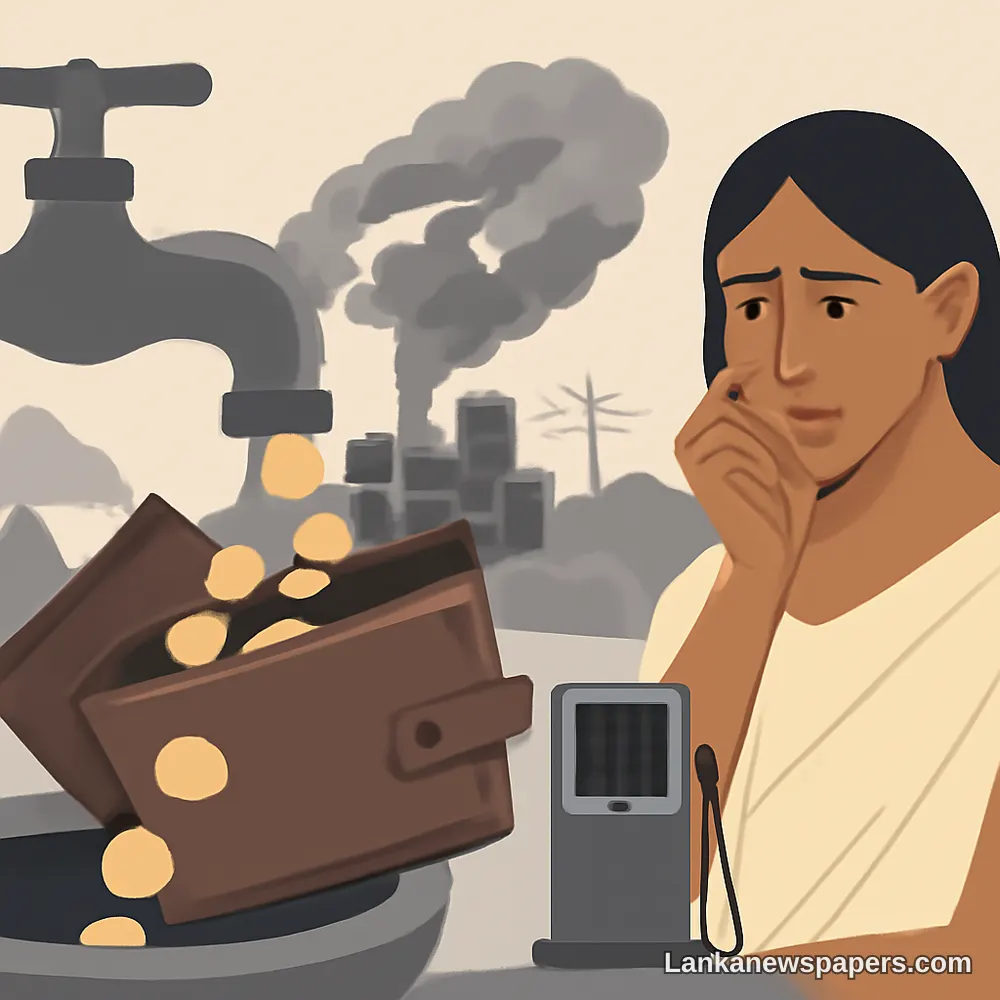
As conflict continues to rage across the Middle East, its economic shockwaves are being felt thousands of kilometres away — in the living rooms, kitchens, and bank accounts of ordinary Sri Lankan families.
A Lifeline Under Threat
For decades, labour migration to the Middle East has served as one of Sri Lanka's most vital economic lifelines. Hundreds of thousands of Sri Lankan workers — from domestic helpers to construction labourers and skilled professionals — have relied on employment in countries such as Saudi Arabia, Kuwait, Qatar, the United Arab Emirates, and Jordan to support their families back home. The remittances they send form a critical pillar of the national economy as well as the financial backbone of countless households island-wide.
But the escalating instability across the region has begun to place that lifeline under serious strain, with Sri Lankan families increasingly reporting rising anxiety, reduced income flows, and uncertainty about the safety of their loved ones abroad.
The Human Cost at Home
Families with relatives working in conflict-affected or conflict-adjacent areas describe a daily struggle with worry and financial pressure. Many migrant workers have seen their employment opportunities shrink, their working conditions deteriorate, or their ability to send money home disrupted as regional economies absorb the shocks of prolonged conflict.
For families who depend almost entirely on remittances to cover school fees, medical expenses, and basic food costs, even a temporary reduction in income can trigger a rapid descent into hardship.
The money stopped coming regularly. We didn't know what was happening. Everything at home — the rent, the children's school — all of it depends on what he sends us.
Such accounts reflect a broader pattern emerging across Sri Lanka's migrant-sending communities, particularly in rural areas where alternative sources of income are limited and the local economy offers few options.
Macroeconomic Implications
Sri Lanka's economy, still recovering from the devastating financial crisis of 2022, remains heavily dependent on worker remittances. Any sustained decline in flows from the Middle East carries significant implications not only for individual families but for the country's broader balance of payments and foreign exchange reserves.
Rising oil prices — a direct consequence of regional conflict — further compound the problem, driving up import costs and adding fresh inflationary pressure at a time when many Sri Lankans are only beginning to recover from years of economic turmoil.
Calls for Government Action
Civil society groups and migrant worker advocates have urged the Sri Lankan government to take proactive steps to safeguard workers in the region, including strengthening consular services, establishing emergency repatriation funds, and engaging diplomatically to protect the rights and safety of Sri Lankan nationals abroad.
They have also called for longer-term policy measures to reduce the country's dependence on Middle East labour migration by investing in domestic employment opportunities — a conversation that successive governments have promised to advance but have struggled to translate into meaningful action.
Resilience Amid Uncertainty
Despite the pressures, many Sri Lankan families say they have little choice but to wait, hope, and adapt. For communities where migration has been a generational tradition and a proven path out of poverty, the prospect of that path narrowing is deeply unsettling.
As the Middle East conflict shows no clear signs of resolution, the silent burden carried by Sri Lankan households is likely to grow heavier — a reminder that the consequences of geopolitical crises rarely stay confined to the regions where they begin.



💬 Join the Discussion 4
See what readers are saying — and add your view.
my brother works in Qatar, he says its not that bad there actually
how is middle east conflict our problem? goverment just needs an excuse
fuel and gas prices already killing us, now this also on top
exactly, my grocery bill doubled this year alone