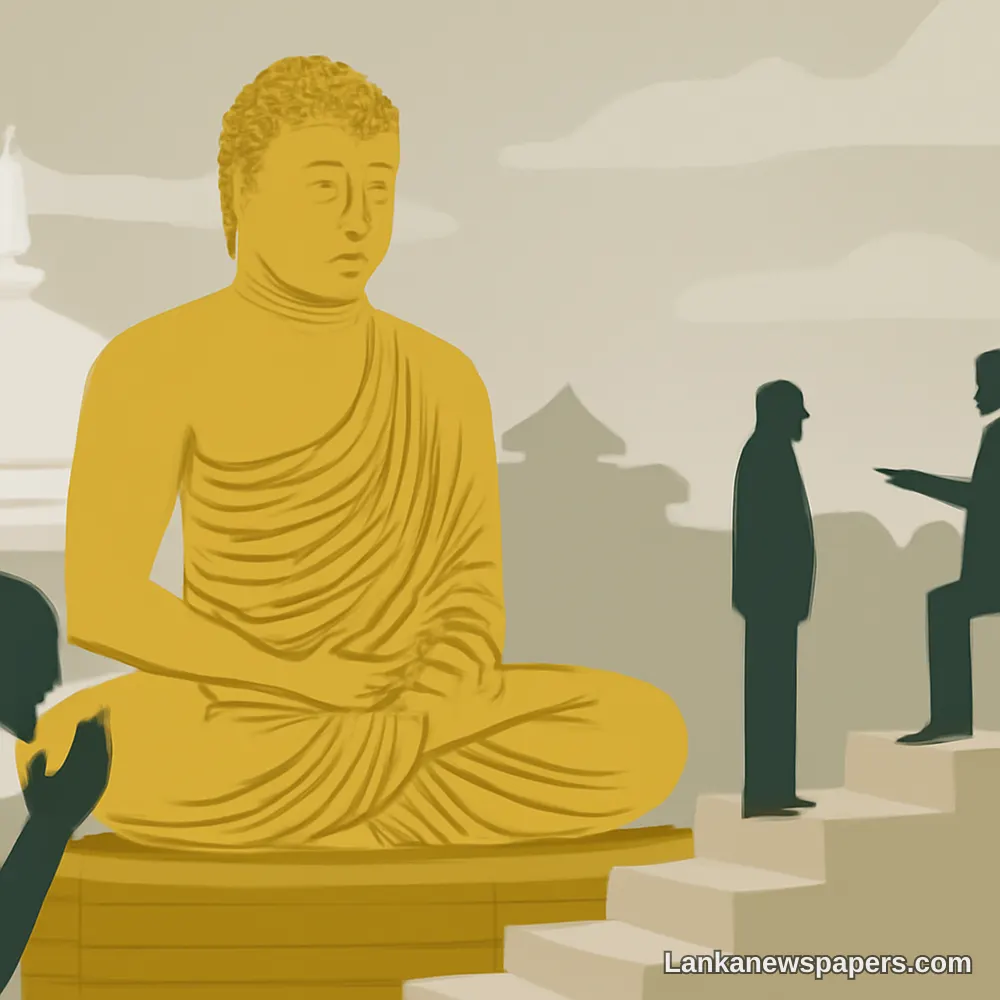
A Sacred Tradition Entangled in Politics and Privilege
Buddhism arrived in Sri Lanka over two millennia ago, carrying with it a profound message of compassion, equality and liberation from suffering. Today, however, many scholars and observers argue that the living practice of that faith on the island bears little resemblance to those founding ideals. Instead, what has emerged is a complex and often troubling entanglement of religious authority, caste hierarchy and political ambition.
The Caste Question the Sangha Refuses to Answer
One of the most persistent contradictions within Sri Lankan Buddhism is the role of caste — a social division that the Buddha himself explicitly rejected. Despite this foundational teaching, caste distinctions have deeply infiltrated the monastic order, or Sangha, for centuries. Certain chapters of Buddhist monks, known as Nikayas, continue to restrict ordination based on caste background, effectively barring those from lower social strata from ascending within the religious hierarchy.
This institutional discrimination stands in stark contrast to the universal brotherhood that Buddhism preaches. Critics argue that the Sangha, rather than challenging social inequality, has at times actively reinforced it, lending religious legitimacy to a hierarchical order that benefits those already in positions of power and privilege.
Political Patronage and the Corruption of Religious Authority
The relationship between Buddhist clergy and political power in Sri Lanka has long been a subject of scrutiny. Historically, kings sought the blessing of the Sangha to legitimise their rule, and in return, the monastic order received land, wealth and institutional protection. This transactional relationship between throne and temple established a pattern that persists into the modern democratic era.
Contemporary Sri Lankan politicians have consistently sought the endorsement of influential Buddhist monks, while sections of the clergy have used their moral authority to advance specific political agendas — often those rooted in Sinhalese Buddhist nationalism. The result has been a gradual drift away from the universal, inclusive spirit of early Buddhism toward an exclusionary identity politics that has, at its most extreme, contributed to communal tension and ethnic conflict.
Nationalism in Robes
The rise of Sinhalese Buddhist nationalism over the past century has been among the most defining — and divisive — forces in Sri Lankan public life. Religious figures have at various points championed policies and rhetoric that marginalised Tamil, Muslim and other minority communities, framing the island as a sacred Sinhala Buddhist homeland in need of protection.
Such movements have drawn both mass popular support and fierce criticism. Detractors contend that deploying religion as a vehicle for ethnic nationalism fundamentally distorts the Buddhist message and has caused immeasurable harm to Sri Lanka's social fabric. Defenders, meanwhile, argue they are preserving a civilisational heritage under threat.
Voices Calling for Reform
Not all within the Sri Lankan Buddhist tradition have accepted this state of affairs without challenge. A minority of progressive monks and lay scholars have consistently called for a return to the ethical core of the Dhamma — one that prioritises social justice, inter-communal harmony and the dismantling of caste-based discrimination within the Sangha itself.
- Reformers have advocated for open ordination processes that do not discriminate on the basis of caste or social origin.
- Some clergy have publicly criticised the use of religious platforms for partisan political purposes.
- Civil society groups continue to document instances where religious authority has been misused to justify discrimination or violence.
These voices, though often drowned out by more powerful institutional interests, represent an important counter-current within Sri Lankan Buddhism.
A Reckoning Long Overdue
For Sri Lanka to move toward genuine reconciliation and social cohesion, many argue that an honest reckoning with the distortions that have taken hold within its dominant religion is essential. That means acknowledging how caste prejudice, political opportunism and ethnic nationalism have corrupted institutions that were meant to stand apart from worldly power.
The Buddha's own life was defined by a renunciation of power and privilege. Whether the institutions established in his name can find their way back to that spirit remains one of the most consequential questions facing Sri Lankan society today.
The path forward, reformers insist, lies not in abandoning Buddhism but in reclaiming it — stripping away the centuries of political and social accretion to rediscover the radical, egalitarian message at its heart.

💬 Join the Discussion 3
See what readers are saying — and add your view.
Himal Southasian is an indian publication, why they writing about our religion
finally someone saying it. monks in politics ruined everything lah
not all monks are bad no. dont generalize like this