President Dissanayake Promises Dedicated Courts for Buddhist Monks, Sparking Rule of Law Concerns
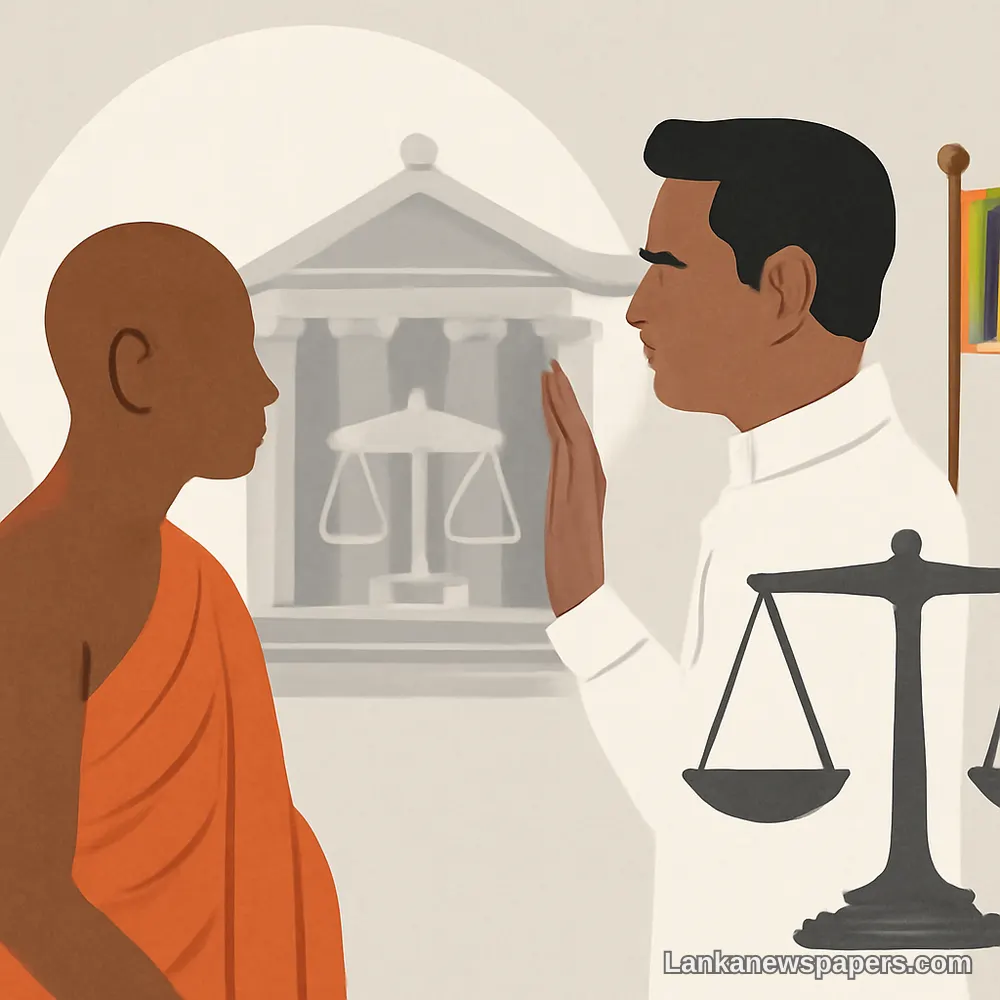
Sri Lankan President Anura Kumara Dissanayake has pledged to establish separate courts exclusively for Buddhist monks, a move that critics argue would place members of the clergy above the standard legal framework that applies to all other citizens of the country.
A Pledge That Raises Constitutional Questions
The proposal, announced by the President, envisions a distinct judicial mechanism specifically tailored for Buddhist monks, effectively creating a two-tier legal system in which members of the Sangha — the monastic community — would be tried and adjudicated under different arrangements than ordinary Sri Lankans.
Legal observers and civil society voices have raised immediate concerns about the implications of such a system, warning that granting a religious group its own court structure fundamentally undermines the principle of equality before the law, a cornerstone of democratic governance and Sri Lanka's own constitutional framework.
Political Context and Religious Influence
Sri Lanka is a predominantly Buddhist nation, and the clergy has historically wielded considerable political influence. Successive governments have sought the backing of powerful Buddhist organisations, and pledges of this nature are widely seen as an effort to consolidate support among religiously conservative constituencies.
Critics, however, argue that pandering to religious institutions through legislative or judicial concessions sets a dangerous precedent, particularly at a time when the country is attempting to rebuild public trust in its institutions following years of economic and political turmoil.
Establishing separate courts for any religious group creates an unequal society where justice depends not on the law, but on who you are — and that is incompatible with a modern democratic state.
Broader Implications for Sri Lanka's Legal System
Sri Lanka's judiciary is already under scrutiny as the nation continues its fragile recovery from the 2022 economic crisis. Legal experts warn that introducing parallel court systems risks further eroding public confidence in an already strained justice apparatus.
Among the key concerns raised are:
- The potential for monks accused of serious crimes to receive more lenient treatment than civilians facing identical charges.
- A constitutional conflict with provisions guaranteeing equal protection under the law regardless of religion or social status.
- The risk of emboldening extremist factions within the Buddhist clergy who have previously been linked to communal violence.
Reactions Across the Political Spectrum
The announcement has drawn mixed reactions. Supporters within religious circles have welcomed the pledge as a gesture of respect toward the Sangha and the nation's Buddhist heritage. Opposition politicians and minority community representatives, however, have condemned the proposal as discriminatory and politically opportunistic.
For Sri Lanka's Tamil and Muslim minorities, who together constitute a significant portion of the population, the prospect of a legal system that affords special privileges to Buddhist monks is particularly alarming, rekindling longstanding anxieties about institutional bias and unequal treatment under the state.
As debate intensifies, all eyes will be on whether the President moves to translate this pledge into concrete legislation — and how the broader public, judiciary, and international community respond to what many are calling a direct challenge to the rule of law in Sri Lanka.

💬 Join the Discussion 1
See what readers are saying — and add your view.
So monks get special courts but ordinary ppl suffer in the backlog for years?