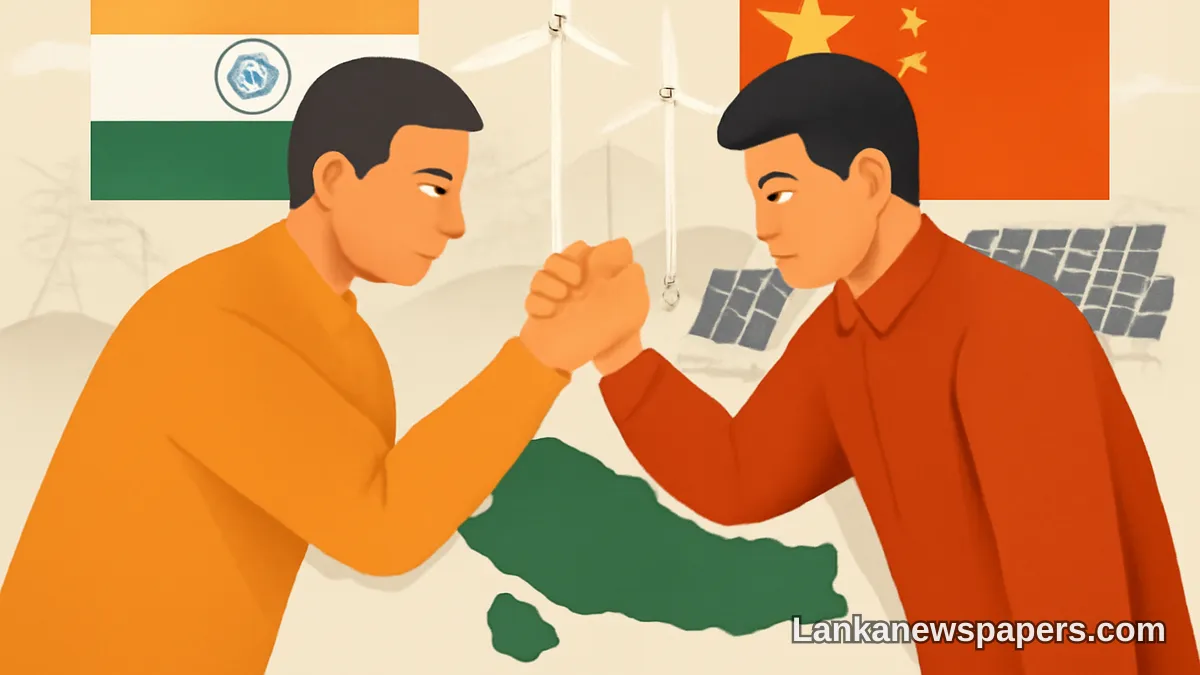
A New Front in the India-China Rivalry
As the global transition toward renewable energy accelerates, South Asia has emerged as a critical battleground for influence between two of the world's largest economies. India and China are both actively expanding their clean energy trade footprint across the region, with Sri Lanka and Nepal serving as key focal points in this intensifying competition.
Sri Lanka's Renewable Energy Landscape
Sri Lanka, still navigating the aftermath of its worst economic crisis in decades, has been actively seeking foreign partnerships to modernise and expand its energy infrastructure. Both India and China have positioned themselves as willing partners, offering financing, technology, and expertise for solar, wind, and hydropower projects across the island.
China's involvement in Sri Lanka's energy sector has deep roots, with significant investments made under the Belt and Road Initiative framework. Meanwhile, India has stepped up its own engagement, keen to counter Beijing's growing regional influence and strengthen bilateral energy ties with Colombo.
Nepal's Hydropower Potential Draws Competing Interest
Nepal, blessed with some of the most abundant hydropower resources in the world, presents a particularly attractive opportunity for both nations. India has long been Nepal's primary partner in hydropower development and electricity trade, but China has increasingly sought to expand its own role in the Himalayan nation's energy sector.
The competition between the two Asian giants in Nepal reflects broader geopolitical tensions, with energy infrastructure serving as both an economic tool and a diplomatic lever.
Key Trends Shaping the Competition
- China has leveraged concessional loans and state-backed enterprises to finance large-scale clean energy projects across both countries.
- India has focused on grid connectivity and cross-border electricity trade agreements as a means of deepening energy interdependence with its neighbours.
- Both nations are promoting solar energy deployment, with competitive pricing and technology transfers forming part of their respective offers.
- Geopolitical considerations play a significant role, with Sri Lanka and Nepal carefully balancing their relationships with both powers.
Implications for Sri Lanka
For Sri Lanka, the competition between India and China could translate into greater leverage when negotiating terms for clean energy projects. However, analysts caution that an over-reliance on foreign financing — regardless of the source — carries its own risks, particularly in light of the country's recent debt sustainability challenges.
Diversifying energy partnerships while maintaining fiscal discipline will be essential for Sri Lanka as it charts a course toward a more sustainable energy future.
A Region at the Centre of the Green Energy Race
As climate commitments tighten and the demand for affordable, clean energy grows across South Asia, the strategic importance of countries like Sri Lanka and Nepal will only increase. How these smaller nations manage their relationships with India and China will have lasting consequences not only for their own energy security, but for the broader regional energy architecture taking shape across the subcontinent.



💬 Join the Discussion 2
See what readers are saying — and add your view.
Both countries just want our resources. dont be fooled by "clean energy" talk.
Exactly. We are just a pawn in their bigger game.