Fitch Adjusts National Ratings of Eight Sri Lankan Banks Following Sovereign Upgrade
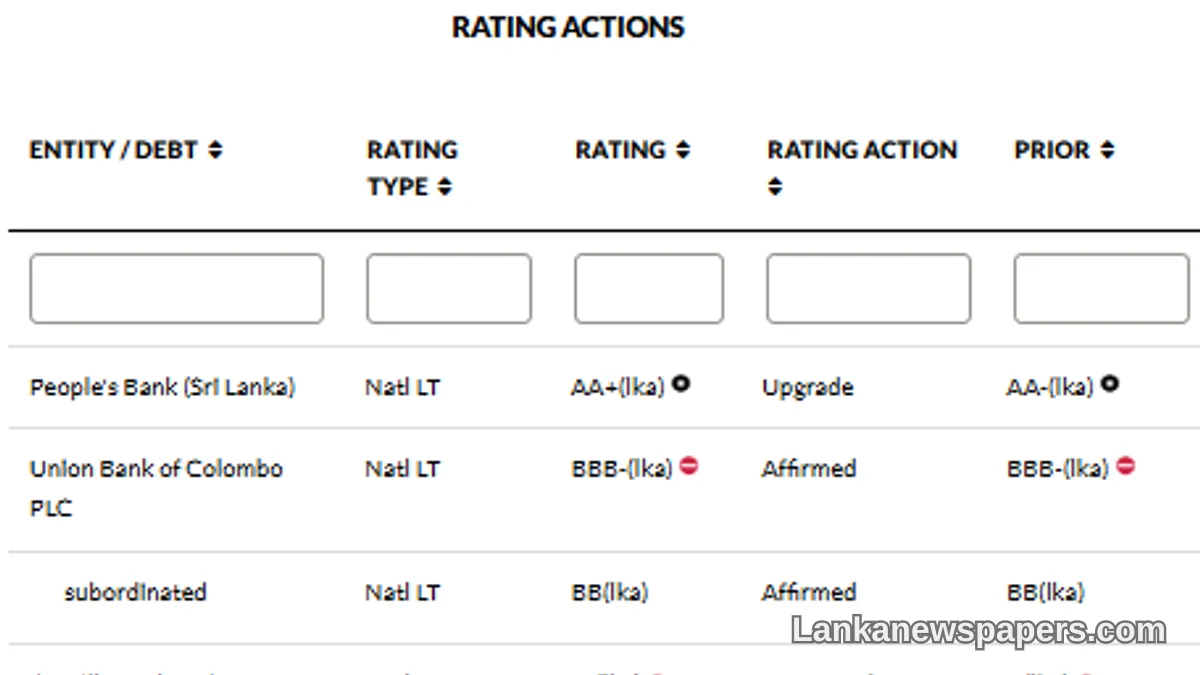
Global credit rating agency Fitch Ratings has moved to recalibrate the national long-term ratings of eight Sri Lankan banks, a development that follows the agency's recent upgrade of Sri Lanka's sovereign credit rating and the subsequent recalibration of its national rating scale for the country.
What Triggered the Rating Actions?
The adjustments are a direct consequence of Fitch's decision to recalibrate its Sri Lankan national rating scale following the sovereign upgrade. National rating scales are benchmarked against the creditworthiness of the strongest issuers within a given country, meaning that when a country's overall sovereign rating improves, the entire national scale shifts accordingly — prompting corresponding rating actions across institutions rated on that scale.
This is a technical recalibration rather than a reflection of any fundamental change in the individual financial health or performance of the banks concerned. The move signals broader confidence in Sri Lanka's improving macroeconomic environment following years of economic turbulence.
Banks Affected by the Recalibration
Among the eight institutions subject to the rating actions is Bank of Ceylon (BOC), one of Sri Lanka's largest state-owned commercial banks. The recalibration encompasses a total of eight banks operating within the country, with Fitch adjusting their national long-term ratings in line with the updated scale.
The affected institutions span both state-owned and private sector banks, reflecting the broad scope of the national scale recalibration exercise.
Significance for Sri Lanka's Financial Sector
The rating adjustments carry considerable significance for Sri Lanka's banking sector, which has been navigating a challenging recovery period following the country's unprecedented economic crisis in 2022. A sovereign upgrade acts as a rising tide for the domestic financial system, as banks' creditworthiness is inherently linked to the ability and willingness of the government to provide support when needed.
For investors and depositors, upward rating movements — even those driven by scale recalibration — can improve market confidence and potentially ease borrowing conditions for banks in both domestic and international markets.
Sri Lanka's Broader Economic Recovery
The sovereign rating upgrade that prompted these actions is itself a milestone for Sri Lanka, reflecting the progress the country has made in stabilising its economy, restructuring its debt, and restoring macroeconomic order under the International Monetary Fund's extended fund facility programme.
Analysts have pointed to improving foreign exchange reserves, a stabilising rupee, and a return to modest economic growth as key factors underpinning the improved sovereign assessment by international rating agencies.
The Fitch recalibration of bank ratings is therefore seen as yet another marker of the gradual but steady restoration of confidence in Sri Lanka's financial system — a welcome development for an economy that is working hard to rebuild its standing on the global stage.

💬 Join the Discussion 4
See what readers are saying — and add your view.
dont trust these rating agencies, they said everything fine before 2022 also
can someone explain what this actually means for normal ppl like us
finally some good news for the economy, about time ratings went up
ratings going up but my grocery bill also going up no difference to us