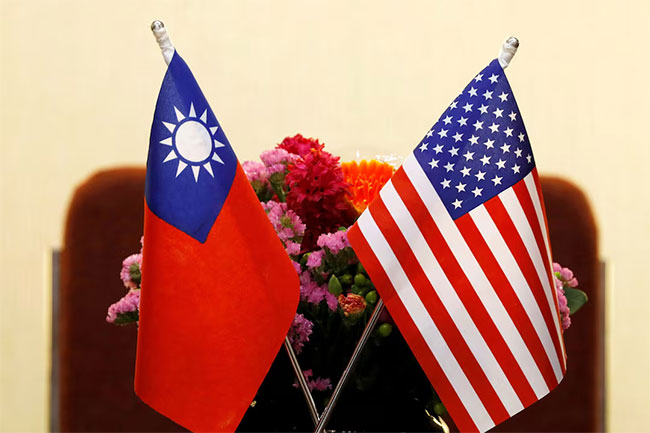
Officials from the Trump administration have finalized a reciprocal trade agreement that sets a 15% tariff rate on imports from Taiwan. In return, Taiwan has agreed to a plan to eliminate or lower tariffs on nearly all U.S. goods. The U.S. Trade Representative’s office released this information on Thursday. The agreement also requires Taiwan to significantly increase its purchases of U.S. goods between 2025 and 2029. This includes $44.4 billion worth of liquefied natural gas and crude oil, $15.2 billion for civil aircraft and engines, and $25.2 billion for power grid equipment and generators, along with marine and steelmaking equipment. This new agreement adds specific details to a trade framework established in January, which reduced tariffs on Taiwanese goods, especially from its strong semiconductor sector, from 20% to 15%. This change puts Taiwan on equal terms with its major Asian trade rivals, South Korea and Japan. Taiwan's President Lai Ching-te expressed on Facebook that this is a crucial moment for Taiwan’s economy and industries to embrace change and transform. He noted that the agreement will improve the Taiwan-U.S. economic and trade framework, create reliable industrial supply chains, and establish a high-tech partnership with the U.S. Furthermore, Taiwan secured exemptions from reciprocal tariffs for over 2,000 product items exported to the U.S., which means the average tariff on U.S. exports to Taiwan will fall to 12.33%, according to Lai. The deal must be approved by Taiwan’s parliament, where the opposition holds the majority. The previous January agreement included a commitment from Taiwan to invest $250 billion in the U.S. for production of semiconductors, energy, and artificial intelligence, which includes $100 billion already pledged by Taiwan Semiconductor Manufacturing Corp. Additionally, Taiwan's government has promised to secure another $250 billion in U.S. investments, as stated by Commerce Secretary Howard Lutnick.
Popular News