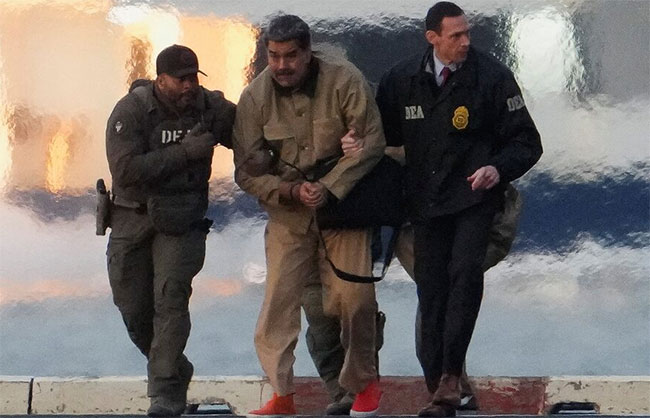
Nicolas Maduro, the ousted leader of Venezuela, arrived at a court in New York on Monday to face charges related to drug trafficking. Meanwhile, the U.N. was set to discuss the legality of U.S. President Donald Trump's unusual operation to take him into custody. This marked the largest U.S. military action in Latin America since the 1989 invasion of Panama. Over the weekend, U.S. Special Forces flew into Caracas by helicopter, breaking through Maduro’s security to capture him outside a secure room. Maduro and his wife, Cilia Flores, who was also taken into custody, were moved from a Brooklyn detention center by armed guards at around 7 a.m. (1200 GMT) on Monday. They were flown to a federal court in Manhattan for a hearing scheduled around noon. Maduro is accused of running a cocaine trafficking network that worked with violent groups, including Mexico’s Sinaloa and Zetas cartels, Colombian FARC rebels, and Venezuela’s Tren de Aragua gang. At 63 years old, Maduro has consistently denied these charges, claiming they are a cover for foreign interests aiming to seize Venezuela’s oil. Despite calling Maduro a dictator and a drug lord who has sent cocaine into the U.S., Trump has openly expressed interest in Venezuela’s vast oil resources, which hold the world’s largest reserves at about 303 billion barrels, primarily heavy oil found in the Orinoco region. However, the oil sector has struggled due to poor management, lack of investment, and U.S. sanctions, producing an average of 1.1 million barrels per day last year, which is only a third of its peak in the 1970s. Initially, Venezuela’s acting president, Delcy Rodriguez, condemned Maduro’s capture as a form of colonial exploitation and kidnapping. However, she shifted her stance on Sunday, stating that it was essential to maintain respectful relations with Washington.
Popular News