by Kusal Perera
I have read and heard of W. Dahanayake travelling to Colombo from Galle in the morning Ruhunu Kumari train with all those other ordinary passengers, getting off at the Kollupitiya station to go to his ministry in Union Place, when he was Co-operative Minister in the J.R. Jayawardne government. That was in early 1980`s.
There were other MPs and Ministers too in the past, who used to travel by train to Colombo, to attend parliamentary sessions. Some even booked sleeping berths, for they travelled through night from
Jaffna or Badulla, to be in parliament for the morning sessions. None of them then would have ever thought of themselves being elected representatives of the people, going about with armed security escorting them. Elected representatives then were escorted by their political supporters, their voters in the village.
The whole concept of an elected representative, despite its legal or constitutional definition, was quite different to that of today. Then a MP was a very publicly accessible icon of political facilitation and not one of political power. They were there to facilitate what their voters wanted and decided, as a constituency. Any breach of trust, or change of perceptions, would leave them out of parliament for a different elected representative at elections. But this is important she or he could not leave that constituency, because it was her or his constituency on public obligations and therefore, she or he was expected to be there for consideration at the next election. They were thus as ordinary as any ordinary citizen in their political life, going about in society as free citizens.
All of it changed, not because of the
LTTE first, but because of the
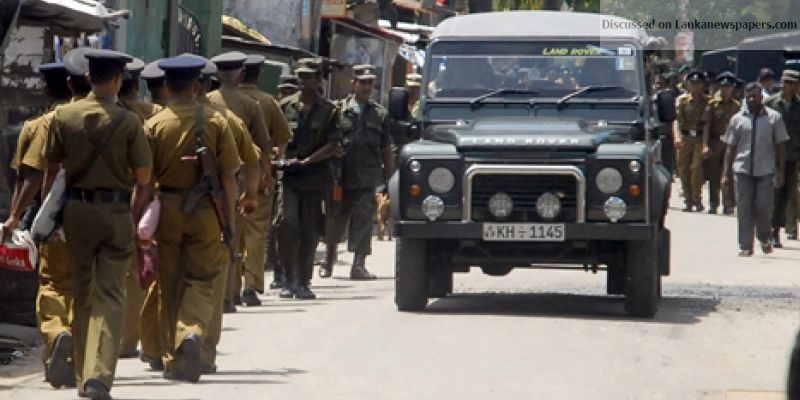
JVP. In 1987 July, when the Indo Lanka Accord was signed, the JVP let loose their opposition to the Accord, by killing those who supported Provincial Councils and came forward to contest PC`s. They vandalised public property, threatened and killed ordinary people in ordinary places and the government was compelled to tighten security in very many ways. Security was made extensive and security intelligence a sophisticated appendage of national security.
This killing spree by the JVP, thus changed the landscape of
Sri Lankan politics since then, with PC Members, political leaders and Members of Parliament (MP) which included Ministers, given armed security. It wasn`t thus easy for people to visit their elected representative, for they were also suspect for the armed security on guard and had to be searched, before allowing entry. Yet, given the brute terror in society, such enhanced security in the country and for politicians became an accepted factor.
Initially, the JRJ government provided 02 armed policemen for all MP`s. The first MP to get special military security then was Mahinda Rajapaksa, although in the parliamentary opposition. Then State Minister of Defence, Late Ranjan Wijeratne the gentleman he was, firmly believed, his uncompromising opposition critic Mahinda Rajapaksa was under threat, though campaigning for human rights in the South. Yet the political culture that Mahinda Rajapaksa was groomed in was so people oriented, he did not want to go about with those uniformed armed security. The two soldiers provided for his security were therefore asked to be in civvies.
All that was in the past, over 20 years ago. The JVP leadership was brutally annihilated in late 1991 under the
Premadasa regime and the JVP DJV (Deshapremi Jantha Viyaparaya the other name used by the JVP) insurgency, wiped out. The few who survived this massacre came out gradually and slowly without arms, to give life to the JVP that we talk of today. Yet the armed security provided for elected representatives, MP`s and PC Members continued turning into and accepted as part of normal life.
There were 02 other reasons that by then had become important for the MP`s to continue with armed security. Especially for government MP`s to begin with. One, the LTTE became a potent force looking for a kill from around mid 1991, after the break down of dialogue with the Premadasa regime. Then again, not all MPs were targeted by the LTTE. Yet all MP`s were provided with armed security and there was no public grudge. Two, the MP`s became more comfortable with security around them as it kept un-served people meeting them, and reminding them of election promises made. They also felt they were powerful personalities, going about with armed security.
All of it helped create a new political culture around individual power. It led to unchallenged corruption too with no questions asked, as to how these politicians become rich half way through their parliamentary life. This armed security and political power have thus become inseparable partners in our political culture. So much so, it is always candidates with such power, with backup vehicles and guards running round, who often get the most preferential votes.